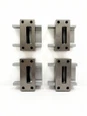
Cemented carbide turning inserts are upgrading from "industrial consumables" to "manufacturing cores", and their technological evolution has become a key engine for the transformation and upgrading of the manufacturing industry, with core impacts focused on the following five dimensions:

Revolutionary improvement in processing efficiency
The cutting speed of the blades is 7 times that of traditional high-speed steel tools, and the service life is extended by 5-10 times (high-end products can reach 80 times). The downtime for tool change is reduced by more than 30%, directly promoting the overall equipment efficiency (OEE) to increase by 15-20%. After being applied by a new energy vehicle enterprise, the single-shift production capacity increased by 15%, saving 2 million yuan in annual tool costs.
II. Continuous Optimization of Manufacturing Cost Structure
Significant reduction in full-life-cycle costs: The annual tool consumption of enterprises can be reduced from 120,000 pieces to 48,000 pieces. The price of domestic high-end tools is only 60-70% of that of imported products, and the comprehensive processing cost has decreased by 20-25%. Combined with the 95% accuracy rate of the intelligent management system in service life prediction, the wrong installation scrap rate has dropped to zero, and material loss has been reduced by 12%.


III. Breaking Through Bottlenecks in Machining Precision and Quality
Nanocoating technology enables cutting tools to withstand temperatures exceeding 1000°C. The 0.2μm ultra-fine grain material controls machining precision within ±0.005mm, reducing surface roughness by 50%. It has met the machining requirements of precision fields such as aero-engine blades (±0.01mm) and medical device parts (0.001mm).
IV. Deep Integration of Intelligent Manufacturing and Green Transformation
Intelligent aspect: Blades with built-in sensors enable self-diagnosis of wear, achieving data interconnection with machine tools and CAD/CAM systems, with the penetration rate of industrial internet management systems exceeding 60%; quick-change systems reduce production changeover time from hours to minutes, and adaptive technologies cut debugging time by 40%.
Green aspect: The recovery rate of cemented carbide has increased from 18% to 30%. The production of recycled materials saves 70% of energy and reduces carbon emissions by 40%; dry cutting reduces the use of cutting fluids by 60%, the penetration rate of green coating technology reaches 43.7%, and unit energy consumption is reduced by 28%.

V. Restructuring the Competitive Landscape of the Manufacturing Industry
Domestic substitution is accelerating. The market share of high-end cutting tools has risen from 35% to 50%, the import dependence has decreased by 2.66%, and exports have increased by 9.8%. The localization rate of key raw material tungsten carbide powder has reached 95%, and the localization rate of cutting tools supporting high-end machine tools is 45% (with a target of 75% by 2025). The independent and controllable capability of the industrial chain has been significantly enhanced.