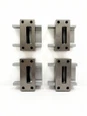
The adaptation scenarios of forming blades for large harvesters can accurately correspond to four dimensions: crop type, operation link, terrain environment, and harvester model. The core application scenarios are summarized as follows:
Ⅰ.Adapting scenarios according to crop types
●Food crops: Thin-bladed blades are used for harvesting wheat and rice in paddy fields/drylands, ensuring that the straw is cut neatly; special-purpose blades are adapted for impact-resistant cutting of tall stalks of corn and soybeans; wear-resistant blades handle the harvesting of densely planted sorghum and millet with hard stalks.
●Cash crops: Narrow-blade knives are used for precise cutting in scenarios where rapeseed has many branches and is prone to lodging; thickened blades are suitable for large-scale harvesting of sugarcane in tropical regions; serrated blades realize the integrated operation of harvesting and crushing of corn stalks and alfalfa silage.
Ⅱ.Adapt to scenarios according to operation links
●Main harvesting operation: As a core cutting component, it is responsible for cutting off the stems of various crops and separating the crops, and is suitable for the key links of the harvesting-conveying front end.
●Straw processing operation: It has both cutting and crushing functions. After cutting the straw into sections, it is directly returned to the field, which is suitable for ecological agricultural planting scenarios.
●Auxiliary operation: Used for cleaning stubble after harvesting, or assisting in the stripping of fruits of special crops such as cutting peanut and potato vines.
Ⅲ.Adapting to scenarios based on terrain and environment
●Large-scale plain planting: High-speed rotating blades are adapted to large combine harvesters, meeting the high-efficiency harvesting needs of a daily operating area at the hundred-mu level.
●Hilly and mountainous area planting: Lightweight blades are suitable for small and medium-sized harvesters, coping with flexible cutting scenarios where plots are scattered and slopes are steep.
●Humid/stoned environments: Blades made of rust-proof and impact-resistant materials are suitable for paddy fields in the south, rainy areas, or plots with gravel in the soil, preventing rust and breakage.
Ⅳ.Adapting scenarios according to harvester models
●Wheel-type combine harvester: Universal blades, capable of harvesting multiple crops such as wheat, rice, and soybeans across different scenarios.
●Crawler-type combine harvester: Anti-slip and wear-resistant blades, ensuring stable cutting under complex road conditions in muddy fields.
●Specialized harvesters (for sugarcane, silage): Customized blades, with edge angles and thicknesses designed according to the characteristics of the machine model, meeting the efficient harvesting needs of specific crops.