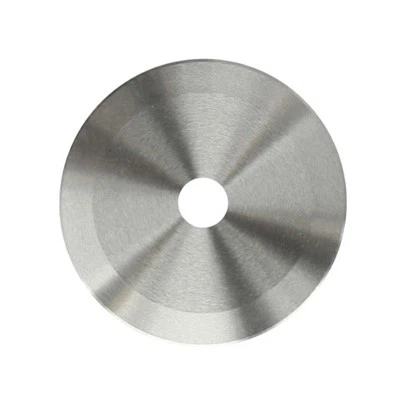
Circular slitter blades are one of the most versatile cutting tools in the industrial realm, known for their precision and efficiency. As a leading supplier of circular slitter blades, I often encounter questions about their application scope, with one of the most frequent queries being, "Can circular slitter blades be used for cutting rubber?" In this blog, I'll delve into this topic, exploring the technical possibility, advantages, challenges, and considerations when using circular slitter blades for rubber cutting.
Technical Feasibility
From a technical perspective, circular slitter blades can indeed be used for cutting rubber. Rubber, as a material, has unique physical properties. It is elastic, flexible, and can vary in hardness depending on its composition and intended use. Circular slitter blades, on the other hand, are designed to rotate at high speeds, creating a continuous cutting action. The sharp edge of the blade can penetrate the rubber's surface and slice through it with relative ease, provided that the blade is properly selected and configured.
The key to successful rubber cutting with circular slitter blades lies in the blade's design and material. The blade must have a sharp cutting edge to minimize deformation and tearing of the rubber. High - quality materials such as high - speed steel (HSS) or tungsten carbide are commonly used for circular slitter blades. These materials offer excellent hardness and wear resistance, ensuring that the blade can maintain its sharpness over an extended period of use.
Advantages of Using Circular Slitter Blades for Rubber Cutting
- Precision Cutting: Circular slitter blades can provide high - precision cuts, which is crucial for applications where accurate dimensions are required. This is especially important in industries such as the automotive and aerospace industries, where rubber components need to fit precisely into specific parts.
- Efficiency: The continuous cutting action of circular slitter blades allows for rapid processing of rubber materials. This can significantly increase production rates and reduce labor costs, making it an attractive option for large - scale manufacturing operations.
- Versatility: Circular slitter blades can be used to cut various types of rubber, including natural rubber, synthetic rubber, and silicone rubber. They can also handle different thicknesses of rubber sheets, from thin films to thick slabs.
Challenges and Considerations
While circular slitter blades offer many advantages for rubber cutting, there are also some challenges that need to be addressed.
- Blade Wear: Rubber is a soft and sticky material, which can cause rapid wear on the blade edge. The rubber particles can adhere to the blade, leading to dulling and reduced cutting performance. To mitigate this issue, proper blade coating and regular maintenance are essential. For example, a titanium nitride (TiN) coating can enhance the blade's hardness and reduce friction, thereby prolonging its service life.
- Heat Generation: The high - speed rotation of the circular slitter blade generates heat during the cutting process. Rubber is sensitive to heat, and excessive heat can cause the rubber to melt or deform. To prevent this, it is necessary to use cooling systems, such as water - cooled or air - cooled mechanisms, to keep the blade and the rubber at a suitable temperature.
- Rubber Elasticity: The elasticity of rubber can make it difficult to achieve a clean and straight cut. The rubber may stretch or bounce back during the cutting process, resulting in uneven edges or inaccurate cuts. To overcome this challenge, proper tensioning and support of the rubber material are required. Specialized fixtures or guides can be used to hold the rubber in place and ensure a smooth cutting operation.
Types of Circular Slitter Blades Suitable for Rubber Cutting
As a circular slitter blades supplier, I offer a range of products that are suitable for rubber cutting.
- Round Packaging Machinery Blade: These blades are designed for high - speed cutting applications in the packaging industry. They can also be used for cutting rubber sheets with precision, thanks to their sharp edges and stable performance.
- Industrial Keyway Circular Slitter Blades | Custom Rotary Round Knife Factory: These blades are specifically engineered for industrial cutting tasks. With their robust construction and high - quality materials, they are capable of handling the challenges of rubber cutting, such as blade wear and heat generation.
- Rubber Cutting Blade: As the name suggests, these blades are optimized for cutting rubber. They are designed with a special geometry and edge treatment to minimize rubber deformation and ensure a clean cut.
Applications of Circular Slitter Blades in Rubber Cutting
Circular slitter blades are widely used in various rubber - related industries.
- Automotive Industry: In the automotive industry, rubber components such as gaskets, seals, and hoses need to be cut to precise sizes. Circular slitter blades can provide the accuracy and efficiency required for mass - producing these components.
- Footwear Industry: Rubber soles are an essential part of footwear. Circular slitter blades can be used to cut rubber sheets into the appropriate shapes and sizes for shoe soles, ensuring a consistent product quality.
- Medical Industry: Rubber is used in many medical devices, such as tubing and seals. The precision cutting provided by circular slitter blades is crucial for ensuring the safety and functionality of these medical products.
Selecting the Right Circular Slitter Blade for Rubber Cutting
When selecting a circular slitter blade for rubber cutting, several factors need to be considered.


- Blade Material: As mentioned earlier, high - speed steel and tungsten carbide are common blade materials for rubber cutting. The choice of material depends on the specific requirements of the application, such as the hardness of the rubber and the expected service life of the blade.
- Blade Diameter and Thickness: The diameter and thickness of the blade affect its cutting performance. A larger diameter blade can provide a wider cutting path, while a thinner blade can reduce the cutting force and minimize rubber deformation.
- Blade Edge Geometry: The edge geometry of the blade, such as the rake angle and clearance angle, can significantly impact the cutting quality. A proper edge geometry can ensure a smooth and clean cut, reducing the risk of tearing or fraying.
Conclusion
In conclusion, circular slitter blades can be effectively used for cutting rubber. They offer precision, efficiency, and versatility, making them a popular choice in various rubber - related industries. However, to achieve optimal results, it is important to address the challenges associated with rubber cutting, such as blade wear, heat generation, and rubber elasticity. As a circular slitter blades supplier, I am committed to providing high - quality products and technical support to meet the diverse needs of our customers.
If you are in the market for circular slitter blades for rubber cutting or have any questions about our products, please feel free to contact us for further discussions and potential procurement opportunities. We look forward to working with you to find the best cutting solutions for your business.
References
- "Cutting Technology Handbook", Industrial Cutting Association
- "Rubber Materials and Their Applications", Rubber Research Institute